I
The speed you didn't choose
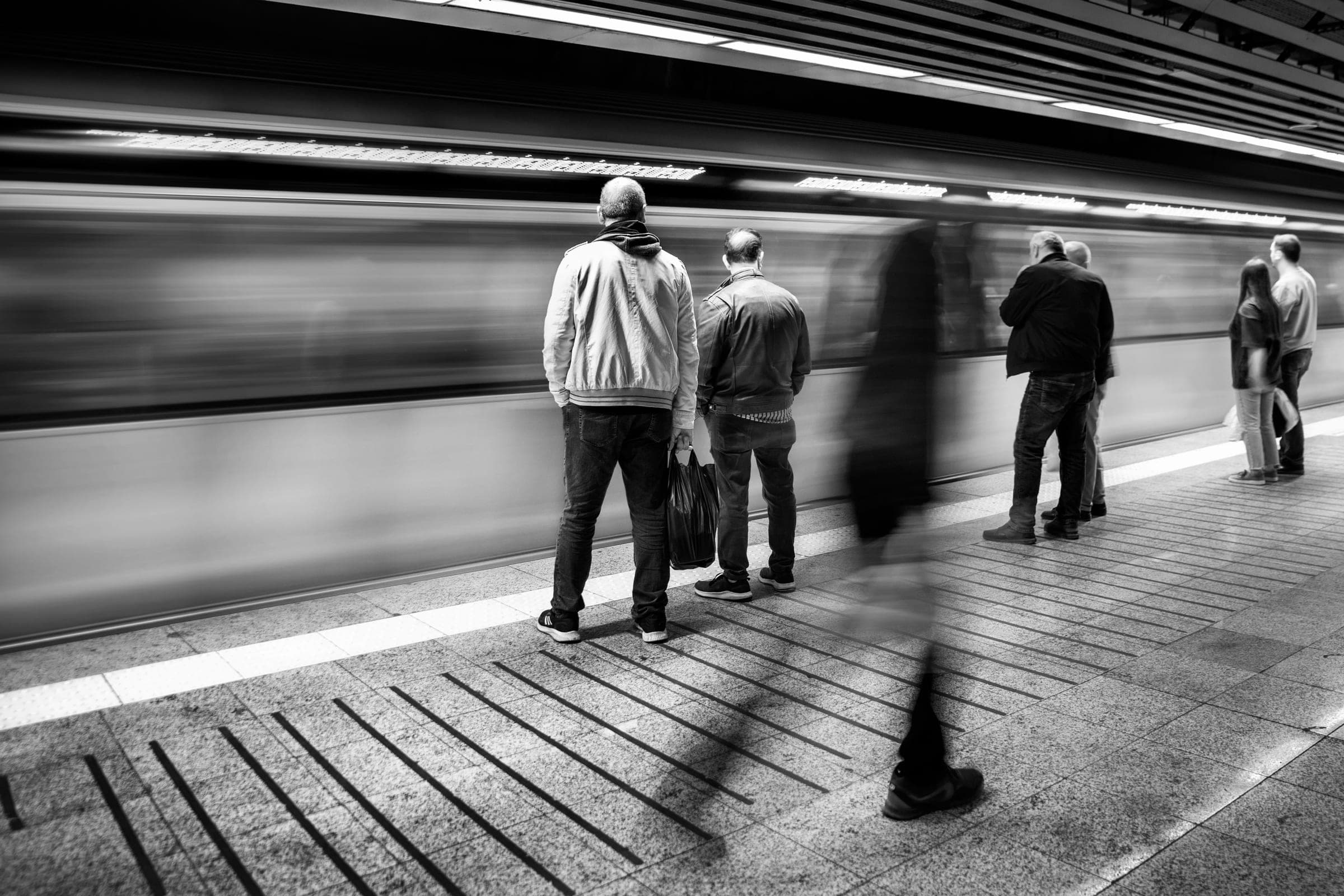
Nobody decided to be this busy. There was no morning when you sat down, weighed the options, and chose a life lived at the speed of a notification. Speed arrived the way weather arrives. It became the default — and the strange part is that it settles heaviest on the people most able to escape it, the ones who could, in theory, be unhurried and somehow never are. Defaults, unlike decisions, are never examined.
Look at where the hours actually go. Not to the work itself, which is often the calmest part of the day, but to the space around it: the message that expects a reply within the hour, the invitation that cannot be declined without a conversation, the group that never stops, the sense that to be reachable is to be responsible. The phone is checked, by most estimates, dozens of times between waking and sleeping — and for this life it is rarely idle scrolling. It is answering. It is appearing. It is staying available to everyone at once. An empty evening reads not as rest but as a vacancy someone will notice. None of this is chosen in any meaningful sense. It is absorbed — from the circle, from the season, from the quiet competitive hum of everyone else appearing to be everywhere.
The cost is not exhaustion, or not only. Research on task-switching has a name for what a crowded day does to a mind: attention residue. Move from one thing to the next without finishing, and part of your attention stays behind, still humming with the last task while you begin the new one. A day of thirty switched tasks is not a full day of work. It is thirty partial presences, stacked. The feeling this produces is now so common we have stopped reporting it: busy all day, certain that nothing truly happened.
Slow living has a marketing problem, because the phrase sounds like an aesthetic — linen, ceramics, a slower kind of shopping. It is none of that. Slow living is the reversal of one specific error: living at a pace that was set by someone else. Slowness is not doing everything at half speed. It is doing the right things at their actual speed — training with full attention, resting without guilt, eating a meal as though the meal were the point. The fast life does many things poorly and calls it efficiency. The slow life does fewer things properly and calls it what it is: a standard.
This is a short book about that reversal — not as philosophy, but as practice. The argument runs through four rooms: how the body actually recovers, how habits actually form, how the home either works for you or against you, and how a week is arranged by someone who has stopped outsourcing their pace. None of it requires a retreat, a sabbatical, or a different city. It requires a decision, made once, and a room to keep it in.
Everything deserves its space. Our thoughts. Our ambitions. Our sense of self. The rest of these pages are about making that space — deliberately, at home, at your own speed.
II
Rest is not the opposite of work
Exercise does not make you stronger. A session of training is a controlled stress — it drains, depletes, and leaves you measurably weaker than when you began. The strength arrives afterward, in the hours and nights that follow, when the body repairs past its previous baseline. Training writes the question. Recovery writes the answer. Which means the fast life has the equation exactly backwards: it treats effort as the productive half and rest as the idle one, when biology runs the other way.
The clearest proof happens while you are unconscious. The body's largest daily release of growth hormone — its principal signal to rebuild tissue — arrives in the first hours of deep sleep, not during the workout. A person who trains six days a week on six hours of sleep is diligently placing orders the body never has time to fill. The training was never the problem. The night was.
Watch anything in nature that stays strong for a lifetime and you find the same arrangement. The house cat — the healthiest athlete in your home — sleeps most of the day, stretches every time it rises, works in short bursts of complete intensity, and rests without a trace of guilt. It has no concept of a rest day that must be earned. Rest is not the reward for effort; it is the larger half of the practice, and the cat gives it the larger half of the day.
What would it mean to take rest that seriously — to give it the same intention we give a training program? Three things, none of them exotic. Sleep treated as an appointment, not a remainder: the same hours, guarded, because the early deep-sleep window does not reschedule itself around a late screen. Movement threaded through the day in small doses — the stretch on rising, the walk after eating — rather than banked into one violent hour. And genuine leisure, the kind with no metric attached: reading, cooking, sitting with people you like, at a table, for longer than necessary.
None of this is idleness. It is the productive half of a life that also works hard — restored deliberately, at home, on purpose. The fast life burns capacity and calls it commitment. The slow life builds capacity and rarely mentions it.
III
The sixty-six days
In one of the most cited studies of habit formation, researchers followed people building a single new daily behaviour and measured how long it took to become automatic — to stop costing willpower. The average: sixty-six days. The range: eighteen to two hundred and fifty-four. Two truths hide in those numbers. Habits take longer than the motivated imagine. And the range is enormous — because how long a habit takes depends less on discipline than on design.
Days. Average 66, range 18–254 — Lally et al. (2010), reference 1.
Every January proves the point at scale. The program gets printed, the streak begins, and somewhere around week six ordinary life returns and collects everything that was built on willpower alone. The failure is so universal that it cannot be a failure of character. It is a failure of design: intensity was asked to do a job that only arrangement can do.
What design means, practically, is friction. A behaviour that requires a commute, a bag, a booking, and ninety unencumbered minutes has four points of failure before it begins. The same behaviour, waiting in a room ten steps from your bed, has none. This is the honest arithmetic behind training at home — not convenience as indulgence, but the deliberate removal of every obstacle between the intention and the act. The people who are still training in March are rarely the most disciplined. They are the ones for whom training is the path of least resistance.
The same arithmetic runs in reverse for the habits you want fewer of. The clearest modern example: in a series of experiments on attention, the mere presence of a person's own phone — silent, face down, untouched — measurably reduced available cognitive capacity. Participants whose phones sat in another room outperformed those whose phones sat on the desk. The phone does not need to ring to cost you something. It only needs to be near.
So the sixty-six days are not a test of will. They are a design brief. Put the mat where you can see it. Put the phone where you cannot. Decide once, arrange the room accordingly, and let the architecture carry what motivation was never built to carry. Willpower is a guest in your life. The room is a resident.
IV
The room decides
Every serious pursuit eventually claims a room. Cooking claimed the kitchen; work claimed the study; sleep has a room so obviously its own that we named the house's most private space after it. The body is the exception. The thing that carries every other pursuit is expected to make do with leftovers.
Usually that means a shortage of space. Sometimes it means the opposite, and the opposite is stranger. A home can have more rooms than are used in an ordinary week — a room kept for guests who come twice a year, a formal sitting room no one sits in, a second home that waits out the seasons. Space is not the problem. Ownership is. Because none of that space is actually yours. It is arranged for how it looks, kept for who might arrive, staged for a life performed rather than lived. A house can be full of rooms and contain not one square metre that answers to your own body.
So the premise of this whole book narrows to a single architectural question, and it is sharper than square footage: not do you have room, but is any of it yours? What happens when one space — however small — stops belonging to appearances and starts belonging to you?
Something specific, and it is not primarily about convenience. A dedicated space is a standing decision. The room decides so you don't have to — that training happens, that rest happens, that this hour is protected, because the space was built for exactly that and silently expects it. Walk past a room made for movement and the room asks something of you. A membership across the city asks nothing; it merely waits, and mostly it waits forever. A guest room asks nothing either — it only waits for guests.
There is also a quieter effect, one interior designers and psychologists circle from different directions: rooms hold meanings. The bedroom that contains a desk never quite lets its owner stop working; the sitting room arranged for visitors never quite belongs to the people who live there. When a space is asked to perform, it stops being inhabited — and the behaviours inside it blur the same way. A room with one clear purpose, and one true owner, produces the opposite: a threshold. Cross it, and the decision has already been made.
Building such a room is not a renovation. It is a subtraction, mostly — and for a home that already has everything, subtraction is the harder luxury. One space — an actual room, or an honest corner reclaimed from a room doing nothing — that belongs to the body and to no guest. Equipment that deserves to be visible, because what is beautiful is allowed to stay out, and what stays out gets used. Light, if you can give it light; the body reads morning light as instruction. And nothing else: no desk, no screen, nothing kept there for anyone else's eyes. The room you make this way does something no membership and no second home can do. It makes the slow life the default — the thing that happens unless you decide otherwise, instead of the thing that happens only if you do.
Make room. The phrase is the whole method. What is given space, happens. What is not, waits — and mostly, it waits forever.
V
Slow is a decision
A week has one hundred and sixty-eight hours. Sleep, taken seriously, claims about fifty-six of them. Work, honestly counted, claims another fifty or so with its commutes and residue. What remains — some sixty hours — is the actual material of a life: the margin in which training, family, meals, rest, and thought either happen deliberately or dissolve into the scroll. The fast life spends that margin by default. The slow life allocates it — once, calmly, like the finite budget it is.
- Sleep56 hrs
- Work, commute and residue50 hrs
- The margin62 hrs
The margin is what is left after the other two — it is the life.
Allocation sounds cold and is the opposite. Ask when training actually happens — which days, at what hour, decided by whom — and vague answers predict abandoned programs with depressing accuracy. The people who keep a practice for years share one unglamorous trait: the arrangement is decided, and the deciding is over. Three mornings for strength. One long slow walk. Meals at a table. A phone that lives in another room after nine. An evening in the week that is simply not available — not to a dinner, not to an appearance, not to anyone. Written down, it looks almost embarrassingly simple. Lived, it is the entire difference between a week that happens to you and a week you conducted.
Two objections arrive on schedule. This is rigid — but the opposite is true: a decided structure is what makes spontaneity affordable, because a life with protected hours can absorb surprise without collapsing, while an undecided life is permanently improvised and therefore permanently anxious. I don't have time — but the hours were always there; the study of any honest week finds them hiding in plain sight. Not lost to work, usually — lost to obligation. The dinner accepted out of duty. The gathering attended so as not to be missed. The season that fills the calendar on everyone's behalf. These are not small pleasures stolen back by a tired person; they are large blocks of a life spent appearing, given away because declining felt harder than going. Slowness does not require more time. It requires the nerve to decide what the existing time is for — and to let some invitations go unanswered.
Notice what has quietly happened across these five chapters. Nothing was added to your life. No program, no retreat, no purchase of a philosophy. Everything was subtraction and arrangement: the pace examined, the rest restored to its half of the equation, the friction moved from the good habits to the bad ones, the body given a room, the week given a shape. Slow living, stripped of its aesthetics, is only this — the refusal to let the defaults decide.
Everything deserves its space. Our thoughts. Our ambitions. Our sense of self. And now, one room at a time, the life that holds them.
Make room for what matters.